Wednesday, May 7, 2014

More Malibu fun with the Meade DSI II OSC 26th April 2014

Its funny how things work out. My last session to Malibu prior to me returning home to the equator for a much needed family break was to be the last two session. Due to bureaucratic in-efficiancy, our trip was delayed yet again and here I found myself at yet another new moon dark sky weekend. Naturally I gravitated to going to Solstice Canyon, my semi dark sky getaway for some fun hours of imaging and observing. Going into the weekend, the weather reports did not look promising at all. The predictions were for cloudy skies and night showers on Friday. Saturday nights weather was supposed to be better, but with windy conditions and partly clear skies. Clear Sky Clock showed heavy cloud cover at midnight. However on checking the chart Saturday morning, the reading changed to 30% cloud cover with windy conditions. The trip was a go!

 "M13, The Great Hercules Globular"

Seeing how this trip was not planned, I had to go back to my star charts to see what I could image. Thankfully its galaxy season, and the Virgo-Coma region is just swarming with small elliptical's and spiral's. The only limiting factor was the wind and when I decide to start my imaging for the night, since my laptop battery only last approximately 2 hours before the battery starts to give the red flag. Turns out the skies behaved really well that night. There were some rather thick'ish clouds off to the south-east early in the night, but that went away pretty quickly. And midway through the session, some wispy high level clouds started drifting from the east and hung around the northeast quadrant of the sky. My solution to this was to ignore that part of the sky and image the clear parts. Thankfully this did not last very long. And contrary to the weather report, there was hardly, if any wind....thank goodness. Plus everything working like clockwork too, with Envisage only hanging once. its it nice to have nights when everything is humming along like a well tuned car engine?

"M61 Galaxy in Virgo"

I usually have with me a second visual scope when going to Malibu. Of late, my scope of choice has been the Edmund Astroscan as it is just so easy to use and carry. Plus it provides very nice bright wide field views, and it does not need a tripod. This time however, I decided to take my newly acquired richest field telescope (RFT), the Orion OmniVista 60mm on alt-az yoke mount. I have only had this scope for about 2 weeks so it was only natural I give it its maiden dark sky first light. Bear in mind that this is a RFT achromat so color is a problem with bright objects. But the purpose of this scope was not for highly magnified views, more so for super wide field views, much like my Edmund Astroscan and my Orion SkyScanner. I tested the scope on and off throughout my session, in between taking a break from imaging. While the scope is easy to use on the alt-az yoke, pointing it was a bit of a pain without a proper finder scope. I had to point in the general direction and pan around to find my objects. And DSO's were dim. I guess I am spoilt as I usually use scopes in the 3" to 10" range. The views were comparable to the previous 60mm scopes I have owned in the past, with a much wider field of view (previous scopes had focal lengths of 700mm versus the 420mm on this wide field scope). Views, as noted, were much "warmer" too due to chromatic abberation. Scope was good for objects covering a large area of the sky though...like open clusters.

Star Map Pro to the rescue 

 "M65 Galaxy in Leo"

Anyways since this trip was not planned, I did not have a list of objects to image. I managed to bag all the objects I had on my important to do list. What is a person to do? Whilst on the bus on the way to work,  I coddled together a list of objects using my favourite iPod app, Star Map Pro. How times have changed. In the past, prior to every trip to Leyburn I would spend so much time rearranging SkyAtlas 2000.0 charts I had printed out in a clear sheet folder, together with a list of objects to hunt down on a piece of paper. These days I do all my visual and astrophotography planning on my iPod Touch, using Notepad and Star Map Pro. Speaking of which I have not realized how much I have come to rely on this good old app. Granted its price of $20, it was not a cheap app by any means. But seeing how many features this lil Star Map/ database holds, I say its worth every penny. It surpasses any of my printed star charts by miles! I have to thank my bot crew buddies (Jenny Lee cut cut, Cher Liew, Kevin FM and J Man Jake) for the iTunes gift card that allowed me this indulgence! Briefly this app pros include:

 "M66 Galaxy in Leo"
  • Huge database of 2.5 million stars and 13,200 deep-sky objects
  • Unique tools for telescopic observers
  • Gives the user almost complete control over what is and isn't displayed
  • Easily accessible brightness controls
  • Extensive help screens 
 "M108 Galaxy in Ursa Major"
It allows one to zoom in an out of  a specific area of the sky, give useful information of DSO's such as rise and set times, transit times as well as images of most of the major DSO's, gives a simulated view of how the FOV will look in a certain eyepieces (yes you can user configure this by putting in your telescope and eyepiece specs and it does automatic simulations) so star hopping is easier, plus you get complete control of the background brightness (and it has a night vision saver feature that allows you to turn the screen red), as well as date and time scrolling (so you can look ahead and see which constellations are up and such)! What's not to like? I think i will be using this app for many years to come!!!!!!!

"NGC 2903 galaxy in Leo"

With that I came up with a huge list that should last me well through spring. Some of the notables in my list galaxies include ones from Virgo, Coma Berenices and Canes Venatici. The ones I did bag that night were M61 in Virgo, M108 in Ursa Major and NGC3521 Leo. I did try for M109 in Ursa Major, but for some strange reason it did not come up. Also re-imaged a couple of objects in Leo, M65, M66, NGC 2903 and NGC 3628. Spent two hours imaging and the last two hours doing some visual astronomy of the summer constellations. Overall a very pleasant trip out to darker skies. next stop...observing from the equator.........

"NGC3521 (top) and NGC 3628 (bottom) galaxies in Leo"


Tuesday, April 15, 2014

Orion OmniVista 60ST Halley's Comet vintage scope review

So here I am with yet another 60mm vintage scope. I have gone through, lets see......Kasai 60ST orange tube 60mm (f/6), Yosco 60mm (f/11.7) metal tube dud, Celestron Cometron CO60 (f/11.7) plastic tube (probably made by Kasai of Japan as well as it is very similar to my Cometron CO40 (f/20) and the Kasai 60ST), Meade blue tube 60mm and now the Orion OmniVista 60ST. If you have been following my blog you would know by now that I have a soft spot for small scopes, especially 80's vintage ones. I can't really tell you why I have an affinity for these scopes. It might be due to the fact that I grew up with astronomy in the 80's and spent heaps of time looking at all those cool ads in the mags and not being able to afford even a measly 60mm scope. Talk about reliving your childhood and teen years!

"The Orion Halley's Comet Special: OmniVista 60 on vintage alt-az mount"

Now I trawl Astromart, the local Craigslist and even e Bay, and do occasionally come across gems for cheap. Most scope sellers are pretty savvy these days and vintage scope (especially complete outfits such as the 60's and 70's produced Unitron's, Sear's, JC Penney's (most of these either Towa's (Circle T), Vixen's (Circle V) and Park's can cost anywhere from $100 to $400 bucks a pop. Yup these "heirloom" quality 60mm long focal length (most come in at between 700 and 910mm focal lengths) are more expensive when they come complete in their wooden box holders, equatorial mounts (some even with clock drives) and a full complement of accessories (mostly 0.965" eyepieces, 2x barlow lenses and moon and sun (sic...these should never be used and should be smashed and thrown away ASAP). One dead giveaway to their 60's and 70's heritage is their metal focus knobs, something rarely seen these days in small 60, 70 and 80mm scopes.

Anyway to cut the story short, while browsing e Bay one lazy Saturday morning, I stumbled across a very familliar looking scope. Now where have I seen this cute lil short tube...oh yes in an ad in my 1985 Orion Telescopes catalog! This scope was released during the Halley's Comet fever era, and was sold on a flimsy looking tabletop tripod, but came with a spring loaded 6x30mm finder, 1.25" rack and pinion focuser and screw on prism diagonal. The scope also came with two 1.25" eyepieces, a 28mm and 15mm. Price back in the day was $229. The one I found did not come complete, the OTA that is. This set is partially complete as the previous owner mounted it on a vintage yoke mount that has slow motion controls in both altitude and azimuth (nice mount by the way). I will have to do a little research on when slow motion controls in azimuth was removed from these small scope mounts. My guess is sometime in the late 80's. The current crop of chinese and taiwanese made small yoke mounts do not have this option. All they have is slow motion controls in the altitude department.

"As the late Steve Irwin would say "Isn't she a beauty"

When released in the mid 80's, the scope did not have a name. I did a little more snooping around on the internet and found out that Orion had indeed given this sweet lil scope a name....Orion OmniVista. I can't find any ad's for this so I am not sure if it was sold as just an OTA or with the tabletop mount as back in 1985. Anyone out there with vintage Orion Catalog's e mail me if you have a copy of this ad!

The OTA itself is very solidly built, and I dare say more solidly built than most of its longer tube brethren. This 20" OTA weights in at a hefty 3.2lb, and this is the OTA alone. The metal retainer ring for the main objective, which only looks to be fully coated (blue reflections only) has the aperture and focal length inscribed onto it (aperture 60mm and focal length 420mm-f/7). The scope, in its native form, comes with a spring loaded, dovetail (non standard and does not accept the current dovetails from the chinese finderscopes....the dovetail is smaller and slips in from the front, with a lock knob down the front too) 6x30mm finder (which is absent in my sample, which comes with a holder that looks like it came from one of them Meade ETX's, but no finder). The focuser knobs are huge for a 60mm scope and are a very sturdy plastic. The rack and pinion focuser is very precise with no play when you rack it in and out of the focuser. It also comes with a focus lock, which will come in handy when you use it for wide field imaging.

"Looking down the barrel of the scope...the business end"

Looking down the business end, I do not see anything that would suggest that the main objective is stoppered down. There is nothing immediately behind the objective. Also looking through the focuser end of the OTA, I can see the objective in its entirety when racking the focuser in and out all the way, suggesting that there is no light cut off from the tube being too short, or the focuser being too long. One quirk of the OTA though is its diagonal. This OTA does not accept the standard 1.25" diagonals (even though it has a focuser in the 1.25" format). What is does have is a thread (not 1.25", appears a little smaller) for the prism star diagonal to screw on that comes with the OTA. I was bummed by this, but upon testing, the prism diagonal seems to work very well with the OTA.

"Aperture=60mm; Focal length=420mm, fully coated optics only"

In the Field


Preliminary inspections out of the way, now it was time to test the scope to see if it performs as well as a 60mm scope should. One problem I often encounter with refractors is miss collimation resulting in imperfect airy discs. A good refractor should have very tight airy disc and the expanding disc should look identical on both sides of the focus. Testing the scope on the stars, the OTA exhibited perfect airy discs and pinpoint stars at the focus point!

"I could get used to this...slo mo on azimuth....something only found on older mounts"

Since I did not have a working finder on the OTA as of yet, I eyeballed bright test objects. In two suburban testing sessions, I observed the 90% illuminated moon (about 1 days out from full moon) and a 4 days past opposition Mars in the evening sky; as well as Saturn and Venus in the predawn sky. I had trouble bagging deep sky objects from my light drenched skies, and the lack of a finder made things even more difficult. Will have to update this blog when I do get the scope under darker skies!

"Slo-mo altitude adjustment, the standard found on todays chinese alt-az mounts"

I used my 24.5mm Meade SWA eyepiece, working at 17x magnification as the finder eyepiece, my 20mm Orion Expanse, working at 21x and my TeleVue 6mm Radian, working at 70x, as my high powered planetary eyepiece. This lil beauty is definately a keeper. Planets were nice and sharp, as was the moon. I had superb, if warm yellow'ish views (typical of fast achromats) of Saturn and its rings, and though I could make out Cassini's division when the seeing steadied. Venus looked very good at 70x too (Seemed to be the best magnification for sharp color free views). I also pushed the magnification above the 60mm maximum limit of 50x per inch with my Orion Shorty Plus barlow to 140x, but CA became a problem and the views dimmed too much. I also used the scope for the total lunar eclipse (14th of April 2014) and even caught some quick looks at a rather featureless Mars at the same magnifications as above. The planetary disc was very sharp though.

"The focuser end showing the screw on metal thread for the prism diagonal"

The mount is of an older vintage as well. This is not a standard issue with this scope, but was a joy to use. There is still that annoying offshoot that one needs to figure in with the altitude adjustment, but I really liked the slow motion control in azimuth. First time using this function on such a small alt-az mount! The flimsy wooden legs are best fully collapsed or extended to about midway since it shakes too much when fully extended. It also comes with one of those triangular plate trays that attach to the mount with wing nuts. I find it easiest to leave one attached to the mount so I can collapse and carry the mount.

All in all I think I got a great bargain for $50 bucks. This scope seems to be a keeper, but only time will tell if I decide otherwise.....

Saturday, April 12, 2014

"Unleashing the the Imaging Monster" with a Meade DSI II OSC

Prologue

"NGC3242: Ghost of Jupiter Planetary in Hydra (top) and M97: The Owl Planetary in Ursa Major""

The long slumber is over. I tried to surpress it, but I can no longer hold it back. It started off as quick shots of the moon and the milky way with a standard bridge digital camera. This escalated into a dedicated deep sky imaging CCD camera. About a year ago I started on this quest, to take images of the our wonderful night sky. My first stop, naturally, was those modified webcams that could be used to take pics of the brighter members of our solar system with a non motorized mount. I figured I would ease my way into the realm of astrophotography. To that, I purchased a Orion Star Shoot Moon and Planetary Imager II. Did not know what I was getting into. Getting the camera to work with my existing scopes itself was a challenge. I quickly learned that one cannot simply attach a camera to the eyepiece of a non motorized telescope and get good images (or images for that matter as the scope needed sufficient back focus!!).


"M62: Black Eye Galaxy in Coma Berenices"

As fate would have it, I chanced upon a cheap Meade Deep Sky Imager I One Shot Color (DSI I OSC) camera on Astromart. That camera coaxed the imaging beast from within, one that was always there, simmering and waiting for a chance to be unleashed. Once a visual observer, I am now more of an astroimager (even though I still stay true to my visual roots and take an hour or two out of every dark sky session to drink in the faint starlight). As a result my observing habits changed. My most used scope went from my big 10" f/5 dob and Celestron/Vixen C6 to a 102mm GOTO Celestron NexStar. This small nifty scope enabled me to spend more time enjoying the views, while imaging or sketching. I also could hit more objects in a night than I previously could. Together with this scope, and camera, I spent countless of nights under Pinos and Malibu skies, imaging as I went along. I spent more than a year with my first DSI I OSC. It was a constant companion of mine, and it went with me everytime I went observing. I was amazed at what it could do, even with my limited equipment and knowledge. My problem was always its limited FOV and small images. The camera worked great. It was just inadequate for larger, sprawling objects. I did do some wide field imaging with a 70mm Celestron Travescope OTA mounted on my NexStar mount.


"M101 (top), M81 (middle), M82 (bottom) galaxies in Ursa Major"

Enter the Meade DSI II OSC 

"M105 group (top), M95 (middle) and NGC2903 (bottom) in Leo"

After some soul searching a decision was made to actively seek out a CCD with a bigger imaging chip that was within budget. Enter the Orion Star Shoot Deep Space Imager II, which had a bigger chip and TEC cooling. Found one for cheap on Astromart so I bit the bullet and purchased it. The camera got as far as my light polluted playground and a single trip to Malibu. The camera was heavier and bigger and used a different image capture software, the industry standard MaxIm DL.  But the camera and software proved to be not as user friendly as the Meade DSI I OSC and the Envisage software. I then put it back up on Astromart and the camera was sold in a flash. Back to the drawing board and my lil Meade DSI I OSC. Then fate came a knocking once again, I found my first camera's older brother, an upgrade, the Meade DSI II OSC with a larger CCD chip and a temperature sensor for dark frames. On testing, the camera performed as well as its little brother. It had the additional advantage (compared to the Orion SSDSIII) of being similar in size, weight and simplicity to the Meade DSI I OSC. I had found my ideal camera (for now)!!!!!!!

"Meade DSI's I (left) and II (right) OSC side by side"

Meade DSI II OSC specs:
Model / Part Number:
Deep Sky Imager II / 04526  

CCD Sensor:
High Sensitivity Color Sony EXview HAD CCDT Sensor (ICX429AKL)  

Chip Dimensions Pixels:
5.59mm (w) x 4.68mm (h); 8mm diagonal (type 1/2) 752 x 582 pixels (437,664 pixels)  

Pixel Size (in microns):
8.3 microns (w) x 8.6 microns (h)  

Temperature Sensor:
Built in temperature sensor measures degrees in celsius and matches it to each dark frame  

A/D Conversion :
16-bit (greater image depth and contrast)  

Min. - Max. Exposure Time:
1/10,000 of a second to one hour  

Housing:
Anodized die-cast aluminum  

USB Compatibility:
High Speed 2.0 and 1.1  

Size / Weight of product:
3.25" x 3.25" x 1.25"/ 10 oz. 


"M94 (Top): The Croc's Eye, M106 (middle) and M63: The Sunflower (bottom) Galaxies in Canes Venatici"

Three weekends on and I finally plucked up the courage to sell my old faithful. I rather it go to someone who would use it heaps, like I did when starting out with astrophotography. This is an awesome lil camera to start with as it greatly reduces the learning curve and can still generate some really pretty snapshots of the deep sky! My only regret with it was not playing around with different image formats. I did not push my lil camera to its limits!!!!!

"M83 galaxy in Hydra"

So after some initial testing from light polluted skies, and experimenting with different file formats (FITS vs TIFF vs BMP) with the Meade DSI II OSC, the imaging bug struck me even harder, much like Mjolnir! I spent the last two weekends imaging from my preferred site, Solstice Canyon park in Malibu.  Seeing how my usual blog goes, I will do a writeup after my dark sky session. I figured I do things a little different this time and write about my experience imaging with the Meade DSI II instead. In total I spent 7 hours imaging and visual observing.


"M84/86 and a portion of the Markarian's Chain in Virgo"

And we are off for some imaging at Malibu 27th March and 5th of April 2014 

"M53 Globular (top) and NGC4565 Galaxy in Coma Berenices"

I spent the eve of Cesar Chavez's day (27th of March) and last Saturday (5th of April) imaging from Solstice Canyon at Malibu. Conditions were rather nice. It was not windy at all, as it was all through Dec, Jan and Feb, and it did not get very cold until midnight hit. Also everything ran oh so smoothly. The mount was humming along just fine and dandy, hitting every object pretty much center or slightly to the left of the FOV on both nights. On most objects, I did not even need to put in the eyepiece to frame the object and then refocus. All I had to do is slew, hit the left or right buttons three to four times and whala...object acquired! The DSI II was also performing very well, as was the laptop. No stalling, no hanging and no frequent updates (the night prior to these two trips were just a weird night when nothing went right). The only small hiccup I encountered was losing some good frames on the 27th of March. I am not quite sure what happened, but that was one of the reasons why I went back this 1st quarter weekend to bag more objects. And I was there late as well since we had a dinner party to attend in Irvine.

M51: The Whirlpool Galaxy in Canes Venatici"

As far as the sessions went, I bagged all the objects I had on my list. Starting at Leo, I polished off NGC 2903 (although I wished I had the better frames, this was one of the objects that did not get saved properly). Then went on to do some old faves such as M81/M82/M97 in Ursa Major, M83 in Hydra, M3/M64 in Coma Berenices and M44/M67 in Cancer. All in all, I managed to go much deeper than with the DSI I. I think this is partly to do with the file formats since I was experimenting with FITS at 32 bit and TIFF at 16 bit. It was here that I learnt that somehow the color balance gets skewered when I save stuff in the FITS format (and combine all four channels, luminence, red, green and blue in MaxIm DL....this is very evident with my M82, M97, M64 and M83 shots pictured in this blog update). Weird? You tell me. Another revelation was that the DSI II had less amp glow than the original DSI I, so I could coax more detail out of the darkness of the frame.

"M12 (top) and M10 (bottom) globulars in Ophiuchus"

When the laptop battery finally died (usually last about 2 hours or more) I went to visual with the Astroscan and the 102GT. The Astroscan is just so easy to use, even easier than the SkyScanner. My fave eyepiece in this one is the 13T6 Nagler. Spent a good amount of observing time looking at all the galaxies (the Leo galaxies M65/M66; M95/M96/M105, Virgo's Markarian chain of galaxies, Coma's galaxies M64, The Blackeye Galaxy; NGC4565, Canes Venatici galaxies M51, The Whirlpool Galaxy; M106; M63, the Sunflower galaxy and M94 as well as big papa bears galaxies M81/M82.

"M8: The Lagoon Nebula in Sagittarius"

Last Saturday was a rushed job as I only got there at 1.30am and imaged all the way till 4.30am, with some visual breaks in between to look at the glorious summer milky way. Can never get enough of M8, the Lagoon Nebula; M20, The Trifid Nebula;, M17, the Swan Nebula;, M16, The Eagle Nebula. Overall a very happy camper. The aim of my next trip therefore will be to re-image summers best and brightest......M20, M17, M16, M57 and M27.......as well as some of the Virgo group of galaxies.....

"M4 Globular (top) and NGC6302: The Bug Nebula (bottom) in Scorpius"

Friday, February 28, 2014

Murphy strikes again.....Solstice Canyon Imaging night 20th Feb 2014

"M46 and NGC 2368 Puppis re-imaged 6x21 sec"

Everything was going so well. Great weather report, transparent skies, little if any wind. So how did my session go...terrible, cause as the title says, Murphy's Law struck yet again. Mount was misbehaving after 30 minutes (remember that I did not image that long the last session so batteries were still pretty fresh!), the Meade DSI I C keep on freezing and to top that off the laptop decided to do a software update right in the middle of my session and that drained the batteries. Least to say I was not pleased at all. It also got really cold despite the warm sunny day we had earlier. Was totally not dressed to handle the cold least to say. Good thing I had my beanie and gloves with me (I never leave home without them!).  Definately not one of my better sessions, but I guess as they say better to be out there than not at all! So I am just not going to write heaps other than the fact I had planned to image the following and failed miserably:

"M53 Coma Berenices 6x15sec, dark subtracted"

M3 Globular Bootes
M53 Globular Coma Berenices
NGC 2359 (Thor's Helmet) Puppis
NGC 1514 Planetary Nebula Taurus
NGC 2903 Galaxy Leo
M63 Galaxy Canes Venatici
M101 Ursa Major

 "M65 Leo 6x21sec, dark subtracted"

Due to problems with the mount, the DSI and focusing (farted around for a while to get the focusing right and that is why I imaged M46....and just when I was ready, NGC 2359 and NGC 1514 were going behind some trees!), and with me getting there at about 10.30pm (Orion and the rest of the winter constellations were slowly sinking behind the canyon walls and trees to the west),  I ended up doing the following:

"M66 Leo 6x21sec, dark subtracted"

M65/66 Galaxies Leo Reimaged
NGC3628 Galaxy Leo
M53 Globular Coma Berenices
M46 and NGC 2368 Puppis Reimaged

"NGC 3628 Leo, the third member of the M65/66 trio 6x21sec, dark subtracted"

I did do some visual stargazing with the Astroscan/13T6 Nagler and the NexStar 102GT but that did not last very long as I was not dressed for the cold. I looked at a couple of galaxies, M104; the Sombrero Galaxy in Corvus, NGC 3242; Ghost of Jupiter Planetary in Hydra, galaxy duo M81/82 and the Owl Planetary; M97 in Ursa Major, galaxy trios M65/M66/NGC 3628 and M95/M96/M105 in Leo, as well as NGC 2903 and of course the Markarian chain M84/M86 and the rest of the Virgo cluster. One of the fave things I used to like doing is start at M59/60 and then meander down the Markarian's chain with my 10" f/5 dob. This this tonight with less aperture! Also took a quick peek at M51; the Whirlpool Galaxy and M64; the Blackeye Galaxy with the Astroscan before the cold go the better of me. Hopefully I get another of such a night, but with everything going well before I head home for the hols at the equator.

Coming next: Imaging with wider fields, testing the Orion SSDSI II replacement (yes i sold it off as I could not get used to the software or the camera!), the Meade DSI II OSC

Wednesday, February 19, 2014

The true temple to the stars...Leyburn, QLD....my dark sky getaway 2001-2010

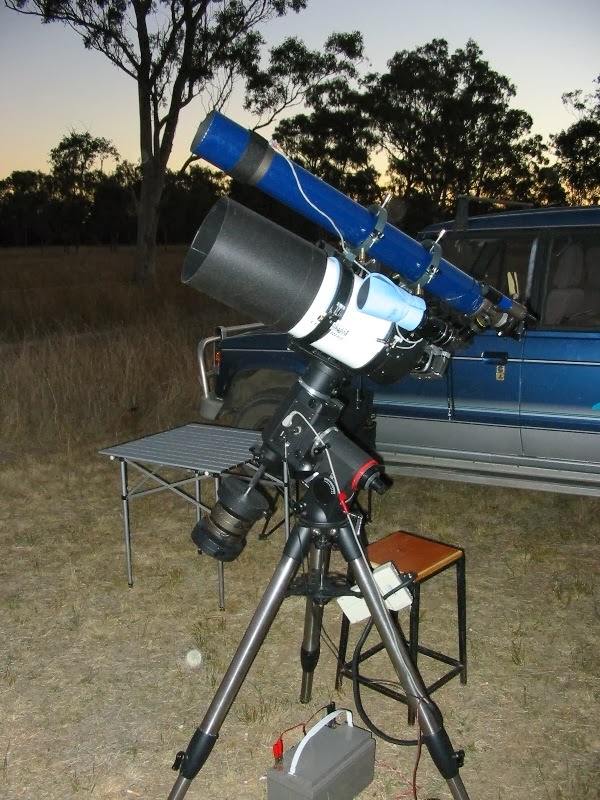
"Leyburn in the early days. Barren field's, large dobs and EQ mounts.....this was my first trip to Leyburn. All three of us packed our gear (and ourselves) into David's Trooper (seen behind Andrew's York Optical 6" f/5 on NES EQ3 mount...similar mount to Orion's SkyView deluxe mount). Center piccie shows David's 10" f/5 GS dob and his then imaging scope 6" Synta refractor on EQ5 mount"

The lousy weather the past couple of weekend's allowed me time to ponder, read my new kindle book "Southern Gems" by Stephen O'Meara and to reminisce about observing locales and times gone by. One of my favourite observing places is Leyburn, Queensland, Australia. If there ever was a paradise on earth for amateur astronomers, the Southern Astronomical Society's dark sky site would surely rank up there as one of the best places in Australia (for me anyway, unless you are out in the boonies and deserts, but then those are not accessible on a regular basis). I remember my first visit to this wonderful site. Thanks to my awesome observing buddy Andrew Durick, who was the first person to welcome me to observing down under. It was Andrew who introduced me to Leyburn and my second real observing buddy David Rigley. I remember fondly the first few months back in oz in 2001 where all I had was a lowly 76mm f/9 navy blue alt-az mounted newtonian, a scope which showed me heaps more than I could have imagined from the darker skies in and around Brisbane. This scope gave me my first "in depth" look at two of my fave winter objects, M57; The Ring Nebula and M27; the Dumbbell Nebula, and from my apartment balcony in Vincent Street, Indooroopilly no less. The skies were heaps darker in the early 2000's. The winter milky way showed structure in the wee hours of the morning when all the lights went out! having two balconies made a big difference, coupled with the fact that the balconies only had beams and no roofing.


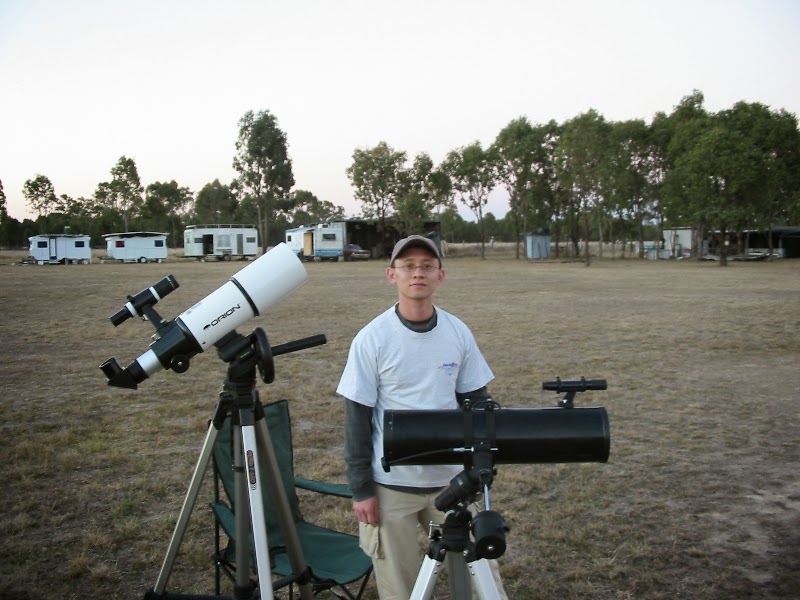
"Leyburn in 2004. Still early days and barren fields. We always occupy the same space when we go together. Andrew and his newly acquired 102ST on the York Optical NES mount from his 6"f/5. David was using a slighly different setup with a Celestron C8 as the main imaging scope and 4" Synta as a guide scope. Note that he was still doing film photography back then. Last pic shows our side of the observing field. Ray standing far left, David seated in the middle and me surrounded by my Celestron/Vixen C6, Andrew's 102ST and my 15x70 binoculars. I traveled with Andrew on several of our outings to Leyburn. He would come pick me up after lunch from UQ and we would swing around to my place at Vincent Street and then start our journey...ah fond memories all!"

The first gathering we ever had was at David's house in a rather light polluted part of town. This was a real eye opener for me. Andrew had his York Optical 6" f/5 on NES EQ 3 mount, and David had his 10" f/5 GS and 6" Synta refractor mounted on an EQ5. Its funny how Andrew's 6" f/5 EQ was more collapsible and easy to transport than my 76mm f/9 alt-az newtonian, as the OTA and the mount would not come apart. It was heaps lighter though. In the early days, David did all the driving to Leyburn. We packed whatever gear we had into his Trooper. Andrew had this 6"f/5 EQ, and I had my 6" Bird Jones EQ which I purchased new in late 2001, with the help of my significant other. David usually had with him his imaging rig, which he had to cart out there. He also brought along a "spare" visual scope (the 10" GS scope which ironically had an Orion labeled eyepiece rack and dust cover (yup the first generation spring loaded GS dobsonian's (the ones with the non dovetail finders) were made by GS in Taiwan, the later batches were made by Synta) with him, and that usually ended up getting used by either me or Andrew. In the old days he imaged with film and used mostly his Synta refractors (he had a 6" and a 4" long focal length refractor), as well as his white tube Celestron C8 on EQ5 mount (and later on a Atlas clone mount).

"Much later years at Leyburn at the peak of winter (yes never again will I go in July.....frost covered everything and I had to wait for my car and scope to thaw out. Notice the same spot where we usually gather. The bottom pic shows Ray (left) and David's (right with his white truck) shed observatories......everyone does digital imaging now! Truss dobs have been replaced by precise GOTO mounts, DSLR's and CCD camera's! Third image on the top right shows the campervan that houses the bunk beds and the kitchen where the mini library lives!"

Sessions usually lasted a night and we usually got there before sundown, set our scopes up, check the collimation and the finderscope alignment. Then it was chill time, where we would either sit down and grab a bite, plan our observing for the night or walk around and inspect other telescopes (mostly large truss dobsonians). Boy how times changed. I remember seeing the transition from a barren field covered with truss dobs, to concrete slabs being erected one by one, as more people turned to astro imaging. In the old days we had David imaging with either his 6" Synta, or C8, and Ray Suckling doing wide field imaging, with Kevin Dixon showing us the night sky treasures through his 16" truss dob. Those were the people I hung around the most with, even while I was crazily hunting down objects on my to do list (which frequently numbered in the 20's or more per session!). There was the occasional large scope treat when Pete Robbin's brought his 30" SDM to the field. Those were some crazy awesome nights! It was here that I had my first real taste of truly dark skies. It was also here that I first learnt of the great celestial emu, which stretched from the coal sack at the bottom of the Crux, all the way through Puppis-Pyxis, and saw the wonders of the south like the great Tarantula Nebula, or Kevin's starfish glob (Pavo glob NGC 6752) and spiral planetary in Musca (NGC 5189), and of course the Magellanic Clouds.

"Leyburn in the hotter months means mozzies that bite through even jeans, balmy to warm weather and camping tents out in full force! From left to right, Andrew's 12.5" truss dob (Ray's observing shed-white and David's imaging shack-green can be seen in the background), my 10" GS  and StarBlast 4.5" dobs.....and my old faithful Hyundai Excel hatchback."

I remember the anticipation of getting there and how we would even risk going there when stormclouds were a brewing (seeing that Leyburn is  2 1/2 hour drive one way up and down the Toowoomba ranges, which helped with shielding the bright lights of Brisbane!). There were a couple of sessions where Andrew and I would go, only to get 1 or 2 hours of sucker hole observations, but we still went. Such was our resolve. The early days also saw us sleeping in the  guest campervan. The campervan had poor insulation and only had three bunk beds (slept 6). I remember getting very bad sleep due to snoring and being very cold. The later trips saw us setting up our own tents or even sleeping in our own cars when it got too cold. I also spent mornings in the adjoining part of the campervan that had cooking facilities and a mini library. Spend some mornings just perusing the nice collection of Astronomy and Sky and Telescope magazines and taking a trip down memory lane with some of those old issues. They even had japanese telescope magazines (I think it was called Tenba) and a copy or of the HB atlas. Ah those were some magical times. At that stage, I never though I would someday move to the northern hemisphere for work. I though I would be observing from southern skies for as long as I lived! I spent a total of 9 years observing from Leyburn (averaging at least 9 to 10 months a year, weather depandant). So many wonderful memories observing under pitch black skies with wonderful friends.


"Leyburn in different seasons. We even setup our tents in the winter...call us crazy ;) The bottom left piccy shows David's imaging rig in his coldroom observatory (yup it was literally a torn down cold room so it offered excellent insulation during the winter months. David was also a big music fan so we usually observed to tunes wafting through from his observatory). Main imaging scope is the C8, with the WO 65 providing wide field shots and guiding. Bottom right pic shows Andrew with his main scope, the 12.5" truss, and his wide field scope."

Alas that was not to be. Jobs and opportunities in my line of work are few and far between in Australia, largely due to research funding. California is the place to be for biotechnology. Granted that it is also a sunshine state, the number of clear skies per year here is staggering. Also since California is largely desert, getting to dark skies is a non issue for me. But the southern skies can never be replaced, and will always hold a special place in my heart. I remember my first truly dark sky moment here in SoCal. It was at Mount Pinos. Skies were dark, close to what we get in Leyburn (largely due to the presence of the marine layer, which is not always present). But I found the northern milky way severely lacking in many aspects. There were no "WOW" objects in the northern skies. As such I found myself once again pining for the southern gems and going south and revisiting the center of our milky way, which skims the pine tree tops in Pinos. Objects I really and truly miss are:
  • Eta Carina Nebula and surrounds
  • Omega Centauri
  • 47 Tucana
  • NGC 6752
  • NGC 6397
  • Tarantula Nebula
  • NGC 5189 Musca Spiral Planetary
  • Coal Sack
  • Large Magellanic Cloud
  • Small Magellanic Cloud
Someday I will return to the land down under, even if it is just for a visit. But Brisbane and Queensland will always have a special place in my heart. Who knows maybe someday I will retire there.....as they say where there is life, there is hope........
"The evolution of a deep sky fanatic. From left to right: My first dark sky trip to Leyburn in mid 2001 with my Bird Jones 6" on EQ3-2 mount. The OTA got replaced with a beat up Celestron/Vixen C6, seen in the middle piccy, which gave wide FOV and sharper views of the planets due to its superior parabolic mirror. Also in the pic is my Orion 80ST on photo tripod for wide field use.....best views of the entire Veil Nebula and the North American nebula was through this scope. The last few years in Leyburn saw me using exclusively the 10" f/5 GS and my Orion StarBlast 4.5" table top dobbie which replaced my most used scopes, the C6 and the Orion 80ST, which I sold after getting the StarBlast in mid 2007"